

- Transactions and records
- Event files
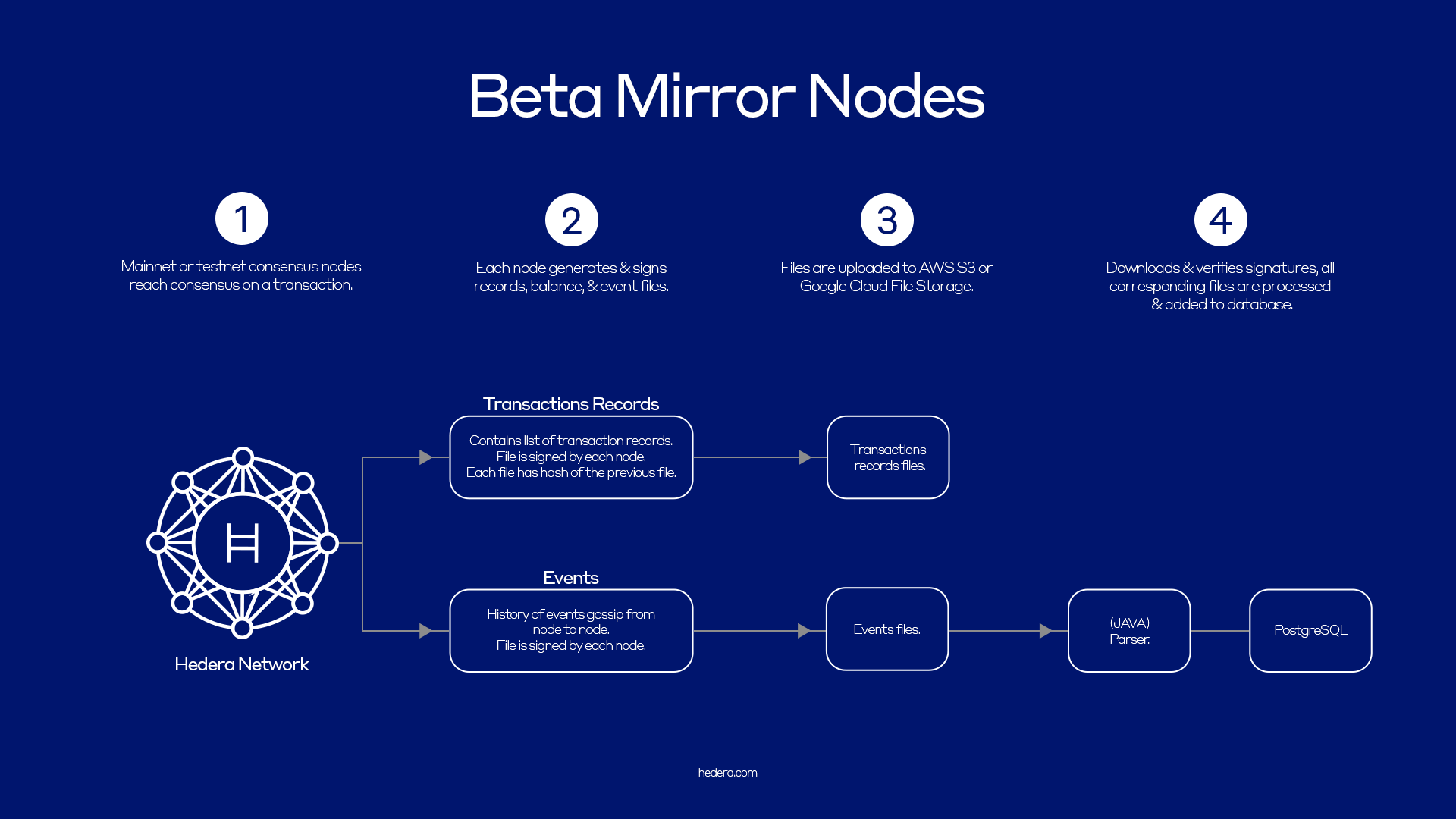
Understanding Mirror Nodes
Hedera Mirror Nodes receive information from Hedera network consensus nodes, either mainnet or testnet, and provide a more effective means to perform:- Queries
- Analytics
- Audit support
- Monitoring
Understanding Block Streams After HIP-1259
For Mirror Node and block stream consumers, HIP-1259 significantly simplifies the data related to transaction fees, leading to smaller block stream files and reduced data ingestion costs.
Simplified Fee Structure
The primary change is the consolidation of all transaction fees into a single transfer to the Fee Collection Account (0.0.802).
- Before HIP-1259: Each transaction record contained multiple fee-related transfers, increasing the size and complexity of the block stream.
- After HIP-1259: Each transaction record now contains only a single, clear fee transfer to
0.0.802. This reduces the amount of data per transaction, making block streams more efficient.
The Daily Synthetic Transaction
A new pattern to be aware of is the daily synthetic distribution transaction. This is a network-generated transaction that occurs once per day at the end of each staking period. It is responsible for distributing the fees accumulated in0.0.802.
As a block stream consumer, you can identify this transaction by the following characteristics:
- It will contain a single large debit from account
0.0.802. - It will have a long list of credit transfers to node operator accounts, the staking rewards account (
0.0.800), the node rewards account (0.0.801), and the network treasury (0.0.98). - It appears in the block stream like any other transaction.
This synthetic transaction is the only time you will see funds being transferred out of the Fee Collection Account. All other transactions involving
0.0.802 will be credit transfers into the account.Benefits for Mirror Node Operators
- Reduced Storage Costs: Smaller block stream files mean lower storage requirements for running a mirror node.
- Faster Data Ingestion: Simpler transaction records can be processed more quickly, improving the speed of data ingestion and synchronization.
- Easier Data Analysis: The fee structure is more straightforward, making it easier to analyze transaction costs and network revenue.
Smart Contract Synthetic Logs
Starting with v0.79 of Hedera Mirror Node release, synthetic event logs for Hedera Token Service (HTS) token transactions have been introduced to mimic the behavior of smart contract tokens. Synthetic events are generated for transactions such as:CryptoTransferCryptoApproveAllowanceCryptoDeleteAllowanceTokenMintTokenWipeTokenBurn
REST API from Hedera
Hedera provides REST APIs to easily query a mirror node that is hosted by Hedera, removing the complexity of having to run your own. Check out the mirror node REST API docs below.Rest API
Run a Mirror Node
Anyone can run a Hedera Mirror Node by downloading and configuring the software on their computer. By running a mirror node, you are able to connect to the appropriate cloud storage and store account balance files, record files, and event files as described above. Please check out the below links on how to get started.Run Your Own Beta Mirror Node
One Click Mirror Node Deployment
FAQ
How is data stored in a Hedera Mirror Node? Is it a specific type of database, or does it use a unique data structure?
How is data stored in a Hedera Mirror Node? Is it a specific type of database, or does it use a unique data structure?
Hedera Mirror Nodes use PostgreSQL databases to store the transaction and event data organized in a structure that mirrors the Hedera Network. Once the mirror node receives record files from Hedera Consensus nodes, the data is validated and loaded into the database.
How do I run my own Hedera Mirror Node? What are the hardware and software requirements?
How do I run my own Hedera Mirror Node? What are the hardware and software requirements?
Setting up a Hedera Mirror Node involves both hardware and software components. The requirements can be found here.To run your mirror node, follow the steps in the “Run Your Own Mirror Node” guide.
Are there costs associated with running a mirror node?
Are there costs associated with running a mirror node?
No, Hedera does not charge for running a mirror node. However, there are costs associated with purchasing the hardware, internet connection, and potential cloud service fees. The hardware and software requirements can be found here.
How do I configure a mirror node and query data?
How do I configure a mirror node and query data?
You can configure your own Hedera Mirror Node by following the step-by-step instructions provided in the “How to Configure a Mirror Node and Query Data” guide. The guide provides instructions on prerequisites, node setup, configuration, and querying the node. Additionally, you can find more details about retention and transaction and entity filtering in the guide.
How can I provide feedback or create an issue to log errors?
How can I provide feedback or create an issue to log errors?
To provide feedback or log errors, please refer to the Contributing Guide and submit an issue in the Hedera Docs GitHub repository.